

Public Exhibition
The Collective Ark
Column-Free Curved Glulam Amphitheatre Structure Engineered to Safely Hold 40 People at Arch:ID 2022

Architect
K-Thengono Design Studio

year
2022

location
Tangerang, Indonesia

size
65 m²
The Brief
Project Overview
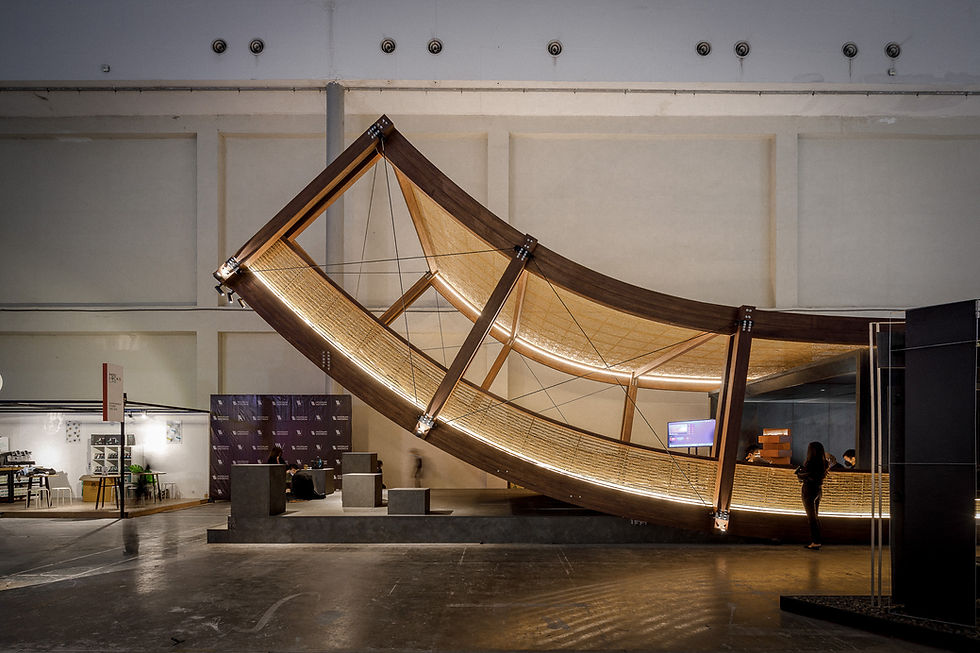
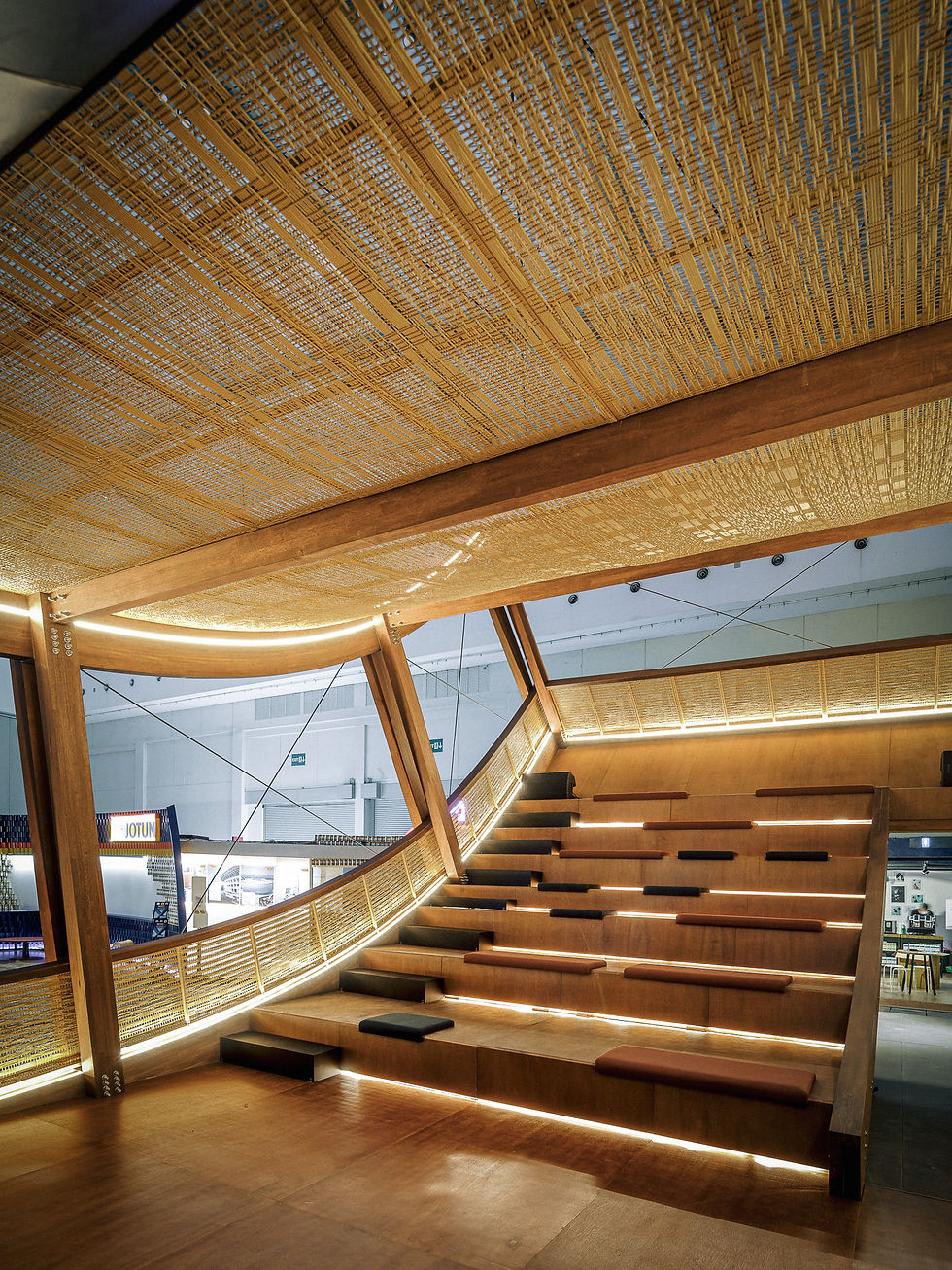
“The Collective Ark” was Woodlam’s structural showcase at Arch:ID 2022, designed as a curved, column-free Glulam amphitheatre supporting 40-person occupancy loads.
The geometry introduced non-linear structural complexity.
Objective
The objective was to validate curved Glulam engineering by proving:
• Public-load capacity on a non-linear structural form
• Custom joint logic for curved assemblies
• Fire-treatment integration without dimensional compromise
• Predictable assembly under exhibition timelines
This installation tested structural timber performance in public occupancy conditions under strict deadline pressure.

The Constraints
Column-Free Curved Load Path
The arc had to carry public occupancy loads without intermediate supports. Curves amplify tolerance errors, so joint fit and geometry control were critical.
Public Safety and Connection Reliability
Crowd loads required conservative assumptions and dependable connector behavior. Assembly had to perform structurally, not just visually.
Fire-Treated Timber Constraints
Fire treatment can affect detailing decisions and fabrication allowances. Dimensional control had to account for treatment and finishing requirements.
Exhibition Build Rules and Time Pressure
Arch:ID delivery required clean, predictable assembly with minimal site adjustment and no wet trades. Sequencing had to be installation-ready.
The Engineering
Curved Glulam Structural Arc
Jabon and Meranti glulam members were engineered into a continuous arc to carry public occupancy loads on curved geometry.
Custom Joint and Load-Path Engineering
The geometry required purpose-built joints and clear load transfer behavior. Connection logic governed structural reliability and alignment, not as an accessory but as the system.
Fire-Treated Timber Integration
Fire treatment was treated as an engineering variable. Detailing and fabrication allowances were resolved early to protect fit, alignment, and surface outcomes.
Prefabrication-First Assembly Logic
The build relied on controlled fabrication and planned sequencing. On-site decision-making was minimized so erection could be fast, clean, and predictable with minimal corrective work.
The Products and Materials

The Results and Insights
Structural Capacity Demonstrated
The pavilion successfully carried its intended audience load on a curved, column-free form, proving the concept as a real structural system, not a one-off sculpture.
Award Recognition
The installation won Best Design Award at Arch:ID 2022, reinforcing the value of structural clarity as an architectural experience.
Curved-Geometry Capability Strengthened
The project expanded Woodlam’s repeatable competence in curved glulam fabrication, tolerance management, and connection detailing under public scrutiny.
Fire Performance as a Design Constraint, Not a Limit
Fire-treated timber was executed without sacrificing precision or architectural intent. This is critical for future public-facing timber work.


Location
Tangerang, Indonesia
Indonesia Convention Exhibition (ICE) Jl. BSD Grand Boulevard No.1 BSD City, Pagedangan Banten, 15339 INDONESIA
Frequently Asked Questions
Got a question unanswered? Speak to our team.
How can a curved timber structure be column-free and still safe for public use?
By treating the curve as a structural system rather than a shape. The arc was engineered to carry load through defined load paths, pre-resolved joints, and stable bracing logic. Member sizing, connection detailing, and tolerance control were resolved together, allowing the curved glulam form to safely carry public loads without intermediate columns.
Why does fire-treated timber change how you design and fabricate a structural pavilion?
Because fire performance requirements affect detailing, surface preparation, and moisture behaviour. Fire treatment must be integrated into engineering and fabrication planning so it does not introduce fit issues, moisture imbalance, or unplanned tolerance shifts during assembly.
What made this structure capable of holding 40 people on a curved form?
Conservative load assumptions, clear load paths, and connection discipline. The capacity is not a single “strong beam” decision. It is the combined performance of member sizing, joint design, and stability control working as one system.
Why was this project strategically important for Woodlam?
It proved Woodlam can engineer structural timber as a public, high-risk system under tight constraints, not only as a material supplier. The outcome is a repeatable capability: curved geometry, controlled joints, fire performance integration, and predictable assembly discipline.
Explore Curved, Column-Free Glulam Structures for Public and Exhibition Projects
Discuss how curved glulam systems can be engineered for public occupancy using precise load-path analysis, custom joint detailing, and fire-performance integration, while maintaining predictable prefabrication and fast on-site assembly for exhibition timelines.