

Private Residence
South Hill
Engineered VPanel Interior System Integrated for High-Rise Residential Fit-Out in Jakarta


Architect
911 Architect

year
2020

location
South Jakarta, Indonesia

size
220 m²
The Brief
Project Overview
South Hills was Woodlam’s first high-rise residential interior deployment in Jakarta.
Unlike landed houses, the project operated under strict building management constraints, controlled delivery windows, lift access limitations, and zero tolerance for rework.
Objective
The objective was to validate VPanel as a high-rise interior system by proving:
• Pre-engineered modular installation sequencing
• Moisture-calibrated timber suitable for air-conditioned towers
• Seamless alignment across walls and joinery interfaces
• Controlled installation within restricted vertical logistics
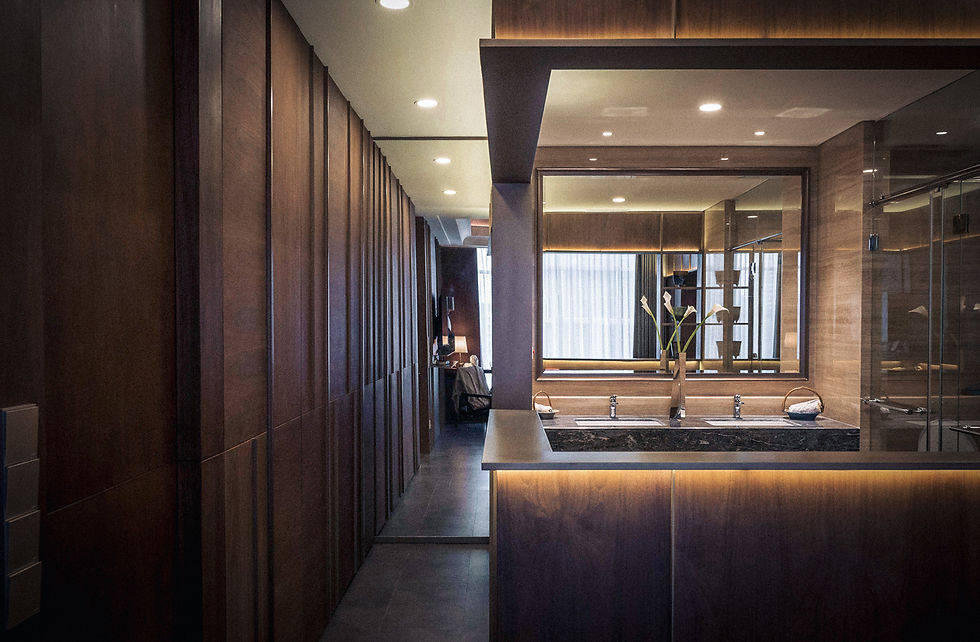
This project demonstrated that precision interior timber can operate within vertical building governance systems.
The Constraints
High-Rise Building Management Controls
Delivery windows were fixed. Lift access was limited. Noise and working hours were restricted. Components had to arrive pre-cut, labeled, and sequenced. Rework was not feasible.
Humidity and Air-Conditioning Cycling
Seasonal humidity shifts and daily AC cycles can drive edge expansion, joint opening, and hardware drift. Interior timber needed engineered stability and controlled moisture calibration.
Minimalist Tolerance Exposure
Flush planes and tight shadow gaps left no room to hide deviation. In minimalist interiors, millimeter-level errors compound across long runs.

The Engineering
VPanel Engineered Interior System
VPanel uses layered construction and an engineered core to stabilize timber surfaces in air-conditioned interiors. The core reduces differential movement, maintaining flatness and predictable reveal conditions compared to solid boards.
Species Allocation Logic
Species selection followed performance needs across zones. Stable machining behavior supported substrate consistency, while finish-critical areas used species selected for controlled grain response and tonal discipline.
Tone matching and grain sequencing were managed to prevent patchwork across connected rooms.
Concealed Fixing and Junction Strategy
Panels were installed using concealed fixing logic to preserve clean planes. Fixing intervals were set to prevent localized face distortion, while joint layouts were coordinated to keep reveals consistent at transitions and returns.
Fabrication and Moisture Control
Panels were pre-cut and pre-calibrated to reduce on-site cutting and tolerance stacking. Components were conditioned to interior moisture targets, and all cut edges were sealed to reduce humidity ingress.
The Products and Materials

The Results and Insights
High-Rise Interior System Validated
VPanel maintained consistent alignment and reveal conditions across the apartment interior under Jakarta humidity cycling and air-conditioning variation.
Regulated Installation Execution Confirmed
The project was delivered within fixed delivery windows, lift limitations, and noise controls without sequencing disruption or site rework.
This validated Woodlam’s ability to execute precision interior timber systems inside managed high-rise environments.
Engineered Stability Reinforced
The project confirmed a repeatable principle: in tropical interiors, engineered panel systems maintain flatness and junction integrity more reliably than solid timber assemblies.
Interior Systems Capability Expanded
South Hills strengthened Woodlam’s execution in:
• Multi-species interior coordination
• Joinery-grade tolerance control across long runs
• High-rise installation sequencing discipline
This was a systems validation, not a decorative outcome.


Location
South Jakarta, Indonesia
INDONESIA
Frequently Asked Questions
Got a question unanswered? Speak to our team.
Why was VPanel used instead of solid timber boards?
VPanel uses an engineered core that stabilizes veneer surfaces, reducing movement and maintaining consistent reveal alignment over time. In this project, engineered panels with sealed edges helped preserve clean junctions and long-run alignment within a regulated high-rise environment.
How was humidity risk managed in this project?
Panels were fabricated at controlled moisture levels, edges were sealed, and installation occurred within a conditioned interior environment. These steps reduced expansion risk and long-term distortion.
What was the main technical challenge?
Executing precision alignment under strict high-rise regulations. Limited delivery windows and no margin for rework required pre-engineered sequencing and exact fabrication tolerances.
What did this project prove for Woodlam?
That engineered interior timber systems can be delivered with structural discipline inside regulated high-rise environments in Jakarta. It validated VPanel as a scalable interior system, not a bespoke decorative solution.